
What is a Compensation Philosophy? (And Why Every Organization Needs One)
A compensation philosophy defines how and why your organization pays the way it does. Here's what it covers, why it matters, and how to build one.


A compensation philosophy is a formal statement that defines how an organization approaches employee pay. It outlines the principles, priorities, and decision-making framework that guide every compensation-related choice — from setting base salaries to structuring bonuses, equity, and benefits.
Think of it as the "why" behind your pay practices. Without one, compensation decisions tend to drift toward inconsistency: one department paying above market while another lags behind, managers negotiating ad hoc raises with no guardrails, and employees left wondering why their coworker doing similar work earns significantly more.
A well-crafted compensation philosophy eliminates that ambiguity. It gives HR, leadership, and managers a shared reference point for how the organization values and rewards work.
What a Compensation Philosophy Actually Covers
A compensation philosophy typically addresses several core questions:
Market positioning — Does the organization aim to pay at the 50th percentile of market rates? The 75th? Does it lead in base pay, or lean more heavily on variable compensation and benefits to stay competitive?
Internal equity — How does the organization ensure pay fairness across roles, levels, and departments? What structures exist to prevent pay compression or unjustified gaps?
Pay-for-performance alignment — To what extent does individual or team performance influence compensation? Is the organization rewarding tenure, output, skills, or some combination?
Total rewards scope — Does the philosophy account only for cash compensation, or does it include benefits, retirement contributions, equity, paid time off, professional development, and other non-cash elements?
Geographic and market differentials — For organizations with distributed or remote workforces, does pay vary by location? If so, on what basis?
These aren't theoretical considerations. Each one has direct implications for recruiting, retention, budget planning, and employee trust.
Why Organizations Need a Documented Compensation Philosophy
Most organizations make compensation decisions. Far fewer have actually written down why they make them the way they do. That gap creates problems.
Consistency in pay decisions
Without a documented philosophy, compensation decisions become personality-dependent. One hiring manager offers top-of-range because they're eager to close a candidate. Another lowballs because they're cautious with budget. Over time, these inconsistencies compound and create pay equity issues that are expensive and difficult to unwind.
Recruiting and retention
Candidates and employees increasingly expect transparency around pay. A clear compensation philosophy lets recruiters explain not just what the offer is, but why. It shifts the conversation from "here's what we can do" to "here's how we think about pay, and here's where you fall within that structure."
For retention, a compensation philosophy signals to employees that pay decisions aren't arbitrary. That perception of fairness matters as much as the actual dollar amounts in many cases.
Legal and compliance protection
Pay equity laws continue to expand at the state and local level. Organizations that can demonstrate a consistent, documented approach to compensation are in a significantly stronger position during audits or litigation than those making case-by-case decisions with no documented rationale.
Budget alignment
A compensation philosophy helps finance and HR speak the same language. When leadership agrees on a market positioning target — say, the 60th percentile for base pay — that becomes a planning assumption for headcount budgets, merit increase pools, and total compensation forecasting.
Common Compensation Philosophy Approaches
There's no single right answer here. The best compensation philosophy is the one that reflects the organization's actual strategy, financial position, and talent market realities. That said, most philosophies fall into a few recognizable patterns.
Market leader (lead strategy)
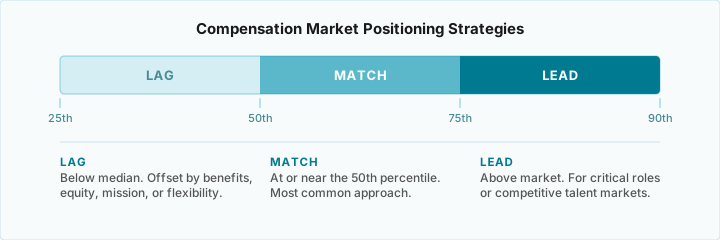
The organization pays above market — typically targeting the 75th to 90th percentile. This approach is common in highly competitive talent markets (tech, finance, specialized healthcare roles) where the cost of unfilled positions or unwanted turnover significantly exceeds the cost of premium pay.
The tradeoff: higher payroll costs and the expectation among employees that pay will consistently stay above market as benchmarks shift.
Market match (match strategy)
The organization targets the market median — roughly the 50th percentile — for base pay. This is the most common approach and works well for organizations that compete on factors beyond cash compensation, such as mission, culture, stability, benefits, or career development.
The tradeoff: less differentiation in recruiting on pay alone, which puts more pressure on other elements of the employee value proposition.
Market lag (lag strategy)
The organization pays below market median, often offset by stronger benefits, equity upside, flexible work arrangements, or mission-driven appeal. Startups, nonprofits, and government organizations frequently fall into this category — sometimes intentionally, sometimes by default.
The tradeoff: higher turnover risk, difficulty filling roles in competitive markets, and potential morale issues if employees perceive the gap as unfair rather than a conscious tradeoff.
Hybrid approaches
Many organizations blend strategies. They might lead the market for critical or hard-to-fill roles while matching for others. Or they might lag on base pay but lead on total rewards when benefits and equity are included. The compensation philosophy should account for and explain these distinctions clearly.
How to Build a Compensation Philosophy
Creating a compensation philosophy isn't a one-afternoon exercise, but it doesn't need to be a six-month consulting project either. Here's a practical path.
1. Assess where you are today
Before deciding where you want to be, understand where you currently stand. Pull compensation data for your roles and compare it to market benchmarks. Identify where you're leading, matching, or lagging — and whether those positions are intentional or accidental.
Look at internal equity as well. Are employees in similar roles with similar experience and performance paid comparably? If not, where are the biggest gaps?
2. Align with leadership on strategic priorities
Compensation philosophy needs to reflect the organization's broader strategy. If the company is in aggressive growth mode, the philosophy may lean toward leading on pay to attract talent quickly. If the priority is profitability and operational efficiency, a match or lag strategy with strong benefits might make more sense.
3. Define your market positioning
Decide on a target percentile for base pay, and determine how total compensation (including bonuses, equity, and benefits) factors into your market position. Be specific. "We pay competitively" isn't a philosophy — it's a platitude.
Specify which market data sources you'll use (published surveys, compensation platforms, industry benchmarks) and how frequently you'll refresh the data.
4. Address pay equity and internal fairness
Document how the organization will maintain internal equity as it grows. This includes job leveling frameworks, pay bands or salary ranges, and regular equity audits. If you don't have these structures yet, the compensation philosophy is a good forcing function to build them.
5. Write the statement
The compensation philosophy itself should be concise — typically one to two pages. It should be clear enough that a manager can read it and understand how to approach a compensation conversation, and transparent enough to share with employees.
Avoid jargon-heavy language that obscures meaning. The goal is clarity, not impressiveness.
6. Communicate and operationalize
A compensation philosophy that lives in a policy folder and never gets referenced is functionally the same as not having one. Communicate it to managers, train them on how to use it in conversations, and reference it in offer approvals, merit cycles, and equity reviews.
What a Compensation Philosophy Statement Looks Like
Here's a simplified example of what a compensation philosophy statement might include:
[Organization Name] is committed to a compensation approach that attracts, retains, and motivates talented employees while maintaining financial sustainability. We target the 60th percentile of market rates for base compensation in our primary talent markets, with total compensation — including benefits, bonuses, and professional development — positioned at or above the 75th percentile.
We use [specific survey sources] as our primary market references, updated annually. Pay decisions are guided by role scope, individual skills and experience, internal equity, and performance. We conduct annual equity reviews to identify and address unjustified pay gaps.
For roles designated as critical or high-demand, we may target up to the 75th percentile to remain competitive. Compensation ranges are reviewed annually against market data and adjusted as business conditions allow.
This isn't a template to copy verbatim — it's a structural example. Your version should reflect your organization's actual targets, values, and constraints.
Common Mistakes to Avoid
Being too vague. "We pay competitively" or "We value our employees" says nothing actionable. A compensation philosophy should include specific market targets, decision criteria, and structural commitments.
Writing it and forgetting it. Compensation philosophies need regular review. Market conditions shift, organizational strategy evolves, and what made sense two years ago may not reflect current realities.
Ignoring total rewards. If your philosophy only addresses base pay, you're missing the full picture. Many organizations are more competitive than they realize when benefits, flexibility, and development opportunities are factored in — or less competitive than they think when those elements are weak.
Failing to account for pay transparency laws. Compensation philosophies should be written with the assumption that employees and candidates will see them — because in many jurisdictions, they now have the legal right to understand how pay decisions are made.
Not involving finance. A compensation philosophy that HR writes in isolation and finance can't fund isn't a philosophy — it's a wish list. Alignment between HR strategy and financial planning is essential.
Compensation Philosophy vs. Compensation Strategy
These terms are often used interchangeably, but there's a useful distinction. The philosophy is the "what and why" — the principles and positioning targets. The strategy is the "how" — the specific programs, structures, and processes used to execute against the philosophy.
For example, a philosophy might state that the organization targets the 60th percentile for base pay. The strategy then defines the job architecture, salary bands, market data sources, and merit increase methodology used to achieve that target.
Both matter. But the philosophy comes first and provides the foundation for everything that follows.
Final Thoughts
A compensation philosophy isn't a luxury reserved for large enterprises with dedicated compensation teams. Organizations of any size benefit from documenting their approach to pay — even if that document is a single page that establishes market targets, equity commitments, and decision-making principles.
The act of writing it forces the conversations that need to happen between HR, finance, and leadership. And once it's written, it becomes a tool that drives consistency, transparency, and trust across every compensation decision the organization makes.

