How to Write a Workplace Guideline (+ Free Template)
Learn how to write a workplace guideline that actually gets used. This guide walks through each section, explains what to include and what to avoid, and includes a free downloadable template.


Most HR teams know they need guidelines. Fewer know how to write one that actually gets used. This guide walks through each section of an effective workplace guideline, explains what belongs (and what doesn't), and includes a free downloadable template to get started.
Key Takeaways
- A workplace guideline needs a clear structure to be useful — not just good intentions.
- Every guideline should include a purpose, scope, key principles, expectations, roles, and an exception process.
- The most common mistake is writing a guideline that reads like a policy — mandatory language, enforcement framing, and no room for judgment.
- A document code and revision history are not optional extras. They prevent version confusion and support audit readiness.
- A free guideline template is available for download at the end of this article.
Skip ahead and download the template.
Why Guidelines Need Structure
A guideline without structure is just advice in a document. It might sound reasonable, but it will not produce consistent behavior across teams, locations, or managers.
The problem is not that organizations lack guidelines. It is that most guidelines are written as loose paragraphs with no clear scope, no defined owner, and no way to tell whether people are actually following them. When that happens, managers interpret the guideline differently, employees are unsure what is expected, and HR has no reference point when questions come up.
Structure solves this. A well-structured guideline answers five questions before anyone has to ask them: Why does this exist? Who does it apply to? What does "good" look like? Who owns it? And what happens when someone needs an exception?
If you are not sure whether your situation calls for a guideline, a policy, or an SOP, start with the core question: Is this mandatory and enforceable, or is it a recommended practice that allows professional judgment? If it is the latter, you need a guideline. For a full breakdown of the differences, see Policies vs SOPs vs Guidelines: Definitions, Differences, and How to Organize Them.
What to Include in a Workplace Guideline
The sections below follow the structure used in our free guideline template. Each section is explained with its purpose, what to write, and what to avoid.
Document Header
Every guideline should open with a metadata block that makes it immediately identifiable and traceable. This is not filler — it is what prevents the "which version is this?" problem that plagues most HR documentation.
Include the following fields at the top of the document:
- Guideline Title — Descriptive and specific. "Remote Work Guideline" is better than "Flexibility Guideline."
- Guideline Code — A unique identifier using a consistent convention. A prefix like GL- (for guideline) followed by a category code and number keeps things organized as your library grows. For example, GL-RW-001 for the first remote work guideline.
- Effective Date — When the guideline takes effect.
- Last Reviewed — When it was last evaluated for accuracy. This field matters more than most teams realize. A guideline with no review date signals to readers that it may be outdated.
- Owner — The role or department responsible for maintaining the guideline. Use titles, not names, so ownership survives turnover.
- Approved By — Who signed off. This adds credibility and clarifies the authority behind the recommendation.
- Applies To — The audience. All employees, a specific department, managers only, or a particular employment type.
Section 1: Purpose
The purpose statement explains why this guideline exists. It should be one to two sentences, focused on the business outcome the guideline supports — not just the topic it covers.
A weak purpose statement restates the title: "This guideline provides guidance on remote work." That tells the reader nothing they did not already know.
A strong purpose statement connects the guideline to an organizational objective: "This guideline establishes expectations for remote work arrangements to maintain productivity, collaboration, and equitable treatment across teams."
The difference matters. When a manager is deciding whether to follow the guideline in an edge case, the purpose statement is what they refer back to. If it is vague, they have nothing to anchor their judgment to.
Section 2: Scope
Scope defines who the guideline applies to and, just as importantly, who it does not apply to. Be specific about roles, employment types, locations, and departments. Ambiguous scope leads to inconsistent application.
Good scope statement: "This guideline applies to all full-time and part-time employees in the U.S. who are approved for remote or hybrid work. It does not apply to contractors or temporary employees, who are covered under their service agreements."
If your guideline applies to everyone, say so explicitly. "All employees" is clear. "The organization" is not.
Section 3: Key Principles
This is the section most guideline templates skip, and it is the section that makes the biggest difference in how consistently the guideline gets applied.
Key principles are the values or priorities that shaped the expectations. They are the "why behind the what." When a manager encounters a situation the guideline does not explicitly address — and they will — the principles give them a framework for making a judgment call that aligns with the intent.
Write three to five principles, each with a short title and a one-sentence explanation. Keep them concrete enough to be useful. "We value flexibility" is a platitude. "Flexibility is a shared responsibility — employees manage their schedules, and the organization provides the tools and expectations to make that work" is a principle someone can actually apply.
Section 4: Expectations
This is the core of the guideline. Expectations describe specific behaviors, standards, or recommended practices that the organization wants employees or managers to follow.
There are two things that make or break this section.
First, the expectations need to be specific enough that someone can tell the difference between following the guideline and not following it. "Communicate effectively" is not an expectation. "Share your working hours and time zone on your calendar so teammates know when you are available" is.
Second, the language must stay advisory. Guidelines use "should," "recommended," and "consider." If you catch yourself writing "must," "required," or "failure to comply," you are writing a policy, not a guideline. The language is the signal. For more on this distinction, see Policy vs Guideline: Key Differences and When to Use Each.
Organize expectations under subtopics (4.1, 4.2, 4.3) when the guideline covers multiple related areas. Number individual expectations so they are easy to reference. "See expectation 4.2.3" is far more useful than "see the part about meetings" when a manager has a question.
Section 5: Roles and Responsibilities
A guideline without assigned roles becomes no one's responsibility. This section prevents the guideline from feeling abstract by clarifying who does what.
Assign responsibilities to roles, not named individuals. People leave. Roles persist. Common assignments include:
- Employees — What they are expected to follow day-to-day.
- Managers — How they are expected to model, reinforce, or monitor the guideline.
- HR or the owning department — Who maintains the document, handles questions, and reviews it on schedule.
If a guideline does not clearly say who is responsible for following it and who is responsible for supporting it, it will drift into irrelevance within a quarter.
Section 6: Exceptions
Every guideline needs an exception path. This is one of the things that separates a guideline from a policy — guidelines explicitly acknowledge that reasonable exceptions will happen, and they describe how to handle them.
State who has authority to approve exceptions, what the process looks like, and whether any documentation is needed. Even a single sentence is better than nothing: "Exceptions to this guideline may be approved by the department head in consultation with HR."
Section 7: Related Documents
List any policies, SOPs, forms, or tools that connect to this guideline. This does two things. It helps the reader find related information quickly, and it helps the reader understand where the guideline sits in the broader documentation hierarchy.
A remote work guideline, for example, might reference the organization's remote work policy (which governs eligibility and data security requirements), the equipment request SOP (which explains how to order a monitor or chair), and the IT security policy (which covers VPN and device requirements).
Section 8: Revision History
Track every version of the guideline with the date, version number, author, approver, and a brief description of changes. This is not bureaucracy. It is the record that proves your organization reviews and maintains its documentation — which matters during audits, employee relations investigations, and onboarding.
Use a simple table format. Include at least the initial release row and leave room for future entries.
A Note on Acknowledgment Pages
Some organizations include an acknowledgment section where employees sign confirming they have read and understood the guideline. This is standard practice for policies, but it is optional for guidelines.
Include an acknowledgment page when the guideline addresses compliance-adjacent topics — data handling, safety practices, or anything where you may need to demonstrate that employees were informed. For general best-practice guidelines like meeting norms or communication preferences, a sign-off is usually unnecessary and can make the document feel more restrictive than intended.
Common Mistakes When Writing Guidelines
Using policy language. If the document says "must," "required," or "failure to comply will result in," it is a policy regardless of the title. Language is the clearest signal of document type. Guidelines use "should," "recommended," "encouraged," and "consider."
Skipping the principles section. Without principles, the expectations have no anchor. Managers will interpret the same guideline differently because they do not understand the reasoning behind it.
No defined owner. A guideline that belongs to everyone belongs to no one. Assign a specific role or department as the owner and include a review cadence.
Writing too much. If a guideline runs longer than two to three pages, it is probably trying to do the work of multiple documents. Consider whether some of the content should be an SOP, a training resource, or a separate guideline.
No exception process. Guidelines that do not acknowledge exceptions get treated as either rigid rules (creating frustration) or optional suggestions (creating inconsistency). Neither outcome is what you want.
Forgetting the review date. A guideline with no review date and no revision history signals to the reader that it may be stale. Even if the content is current, the absence of a date undermines confidence in the document.
Guideline vs Policy: A Quick Language Reference
The language you use in a document is the clearest signal of whether it is a guideline or a policy. This table provides a quick reference when drafting.
| Signal | Guideline Language | Policy Language |
|---|---|---|
| Directive | Should, recommended, encouraged | Must, required, shall |
| Flexibility | Consider, when possible, as appropriate | At all times, without exception, in every case |
| Consequence | Coaching, feedback, manager discretion | Corrective action, disciplinary measures, up to and including termination |
| Exceptions | Exceptions may be approved by the department head | No exceptions without written approval from [authority] |
| Ownership | Maintained by [department], reviewed [cadence] | Approved by [executive/legal], effective [date] |
If you find yourself mixing language from both columns in the same document, stop and decide which document type you are actually writing. Mixed signals create confusion about what is enforceable and what is advisory.
For a deeper comparison including a decision framework, real-world scenarios, and common mistakes, see Policy vs Guideline: Key Differences and When to Use Each.
Download the Free Guideline Template
The template below follows the structure outlined in this article. It includes every section discussed above — document header, purpose, scope, key principles, expectations, roles, exceptions, related documents, and revision history — with placeholder text and practical instructions throughout.
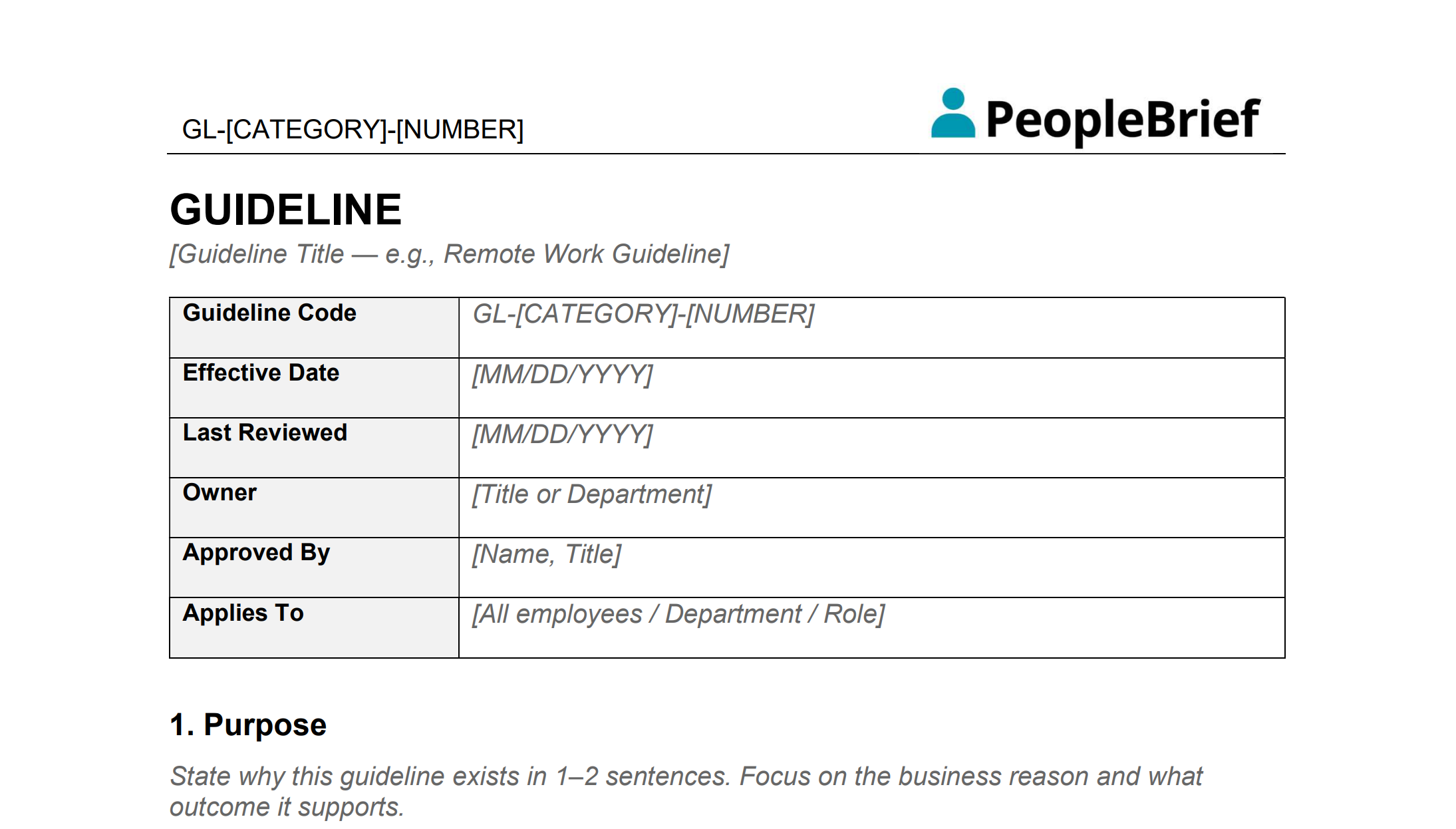
The template is a .docx file that works in Microsoft Word, Google Docs, and other word processors. Customize it with your organization's name, branding, and content. For guidance on what a guideline is and when to use one instead of a policy, see What Is a Guideline? Definition, Examples, and How It Differs From a Policy.
Frequently Asked Questions
What sections should a workplace guideline include?
At minimum, a workplace guideline should include a purpose statement, scope, key principles, expectations (the core recommendations), roles and responsibilities, an exception process, related documents, and a revision history. A document header with an ID code, effective date, owner, and approver adds traceability and supports version control.
How long should a workplace guideline be?
Most effective guidelines are one to three pages. If the document is running longer, some of the content likely belongs in a separate SOP, training document, or additional guideline. The goal is a document someone can reference quickly — not a comprehensive manual.
What is the difference between a guideline and a procedure?
A guideline describes recommended practices and allows professional judgment. A procedure (SOP) provides step-by-step instructions designed to be followed the same way every time. Guidelines answer "what should we aim for?" while procedures answer "how exactly do we do this?"
How often should guidelines be reviewed?
Most organizations review guidelines annually or semi-annually. Guidelines tied to fast-changing topics — technology use, remote work, recruiting practices — may need more frequent review. The key is setting a review cadence and tracking it in the revision history so the document stays current and credible.
Can a guideline become a policy?
Yes. If an organization finds that inconsistent application of a guideline is creating risk, confusion, or compliance issues, that is a signal the topic may need a policy instead. The transition involves adding mandatory language, defining consequences for non-compliance, and routing the document through formal approval. See Policy vs Guideline for a full comparison.
Do employees need to sign an acknowledgment for a guideline?
Not always. Acknowledgment signatures are standard for policies but optional for guidelines. Include one when the guideline covers compliance-sensitive topics or when your organization requires documentation that employees were informed. For general best-practice guidelines, a sign-off is usually unnecessary.
Bottom Line
A guideline is only as useful as its structure. Without a clear purpose, defined scope, and practical expectations, even well-intentioned guidelines get ignored, misinterpreted, or applied inconsistently across teams.
The framework in this article — and the free template — gives HR teams a starting point that covers the sections that matter: why it exists, who it applies to, what "good" looks like, and who owns it. Start with the template, customize it for your organization, and pair it with clear language that signals advisory intent rather than mandatory compliance.